The best usability fixes a problem nobody thought to report
If you live in Mexico you know the “garrafón,” the big jug of drinking water that sits on a stand. You tip it to fill a pot, and out comes that glug, glug, glug. Air punches in, water surges out in bursts, and if the jug is full you spill on the floor.
I never thought of that as a problem. It was just how “garrafones” work, and that is it.
For years I bought Ciel, the Coca-Cola brand. Then one day the store was out of Ciel, I needed water, so I grabbed an Epura, which is Pepsi’s. I filled a pot from it and it did not glug. Smooth pour, no surging, no spill. I looked at the mouth: wider than the rest, maybe fifteen centimeters across instead of the usual ten. Wide enough that air comes in on one side while water leaves on the other, steady, no bubbles fighting their way up. That is the whole trick. A bigger hole.
The part that stuck with me: if anyone ever saw the glug as a problem, I never met them. The big brands all ship the same narrow mouth, and we live with it. Epura went and fixed something the rest of us never thought to question. Why does this spill, and what if it did not?
That is usability at its best, a problem that disappears. You do not stand there admiring the wide opening. You stop mopping the floor and, without knowing why, you like this one better.
Does it help Epura? I cannot give you their sales. I can give you one data point: me. I grabbed that first Epura by accident, and I have bought only Epura since. A sample size of one, but it flipped me, and it flipped me before I could explain why.
Invisible usability is strange that way. It wins loyalty you cannot put into words, and that same invisibility makes it brutal to justify on both ends. Outside: how do you advertise the absence of a problem nobody knew they had? Inside: how do you fund it? A wider mouth means new molds and a new line, millions of pesos, to fix something almost nobody calls a problem, and you cannot build a business case for a pain nobody reports. The fix that quietly wins customers is the one nobody funds. That is probably why nobody has copied Epura.
And the “garrafón” is not a one-off. Epura’s one-liter bottle is taller and thinner, and it drops right into a car cupholder. Bonafont, Ciel, and the rest sell a wider bottle that does not fit, so it rolls around on the seat. As far as I can tell, everyone copied Ciel’s shape. When I buy bottled water, I reach for Epura for that too. These days I rarely buy any, I carry my Kinto everywhere, but the pattern is the point: the same company keeps making the small call the rest skip.
When I build, spotting a small annoyance is the easy part. The hard part is judging which ones are worth the cost, because most are not. Epura bet on this one. It won me, and I still cannot tell you if the bet paid off.
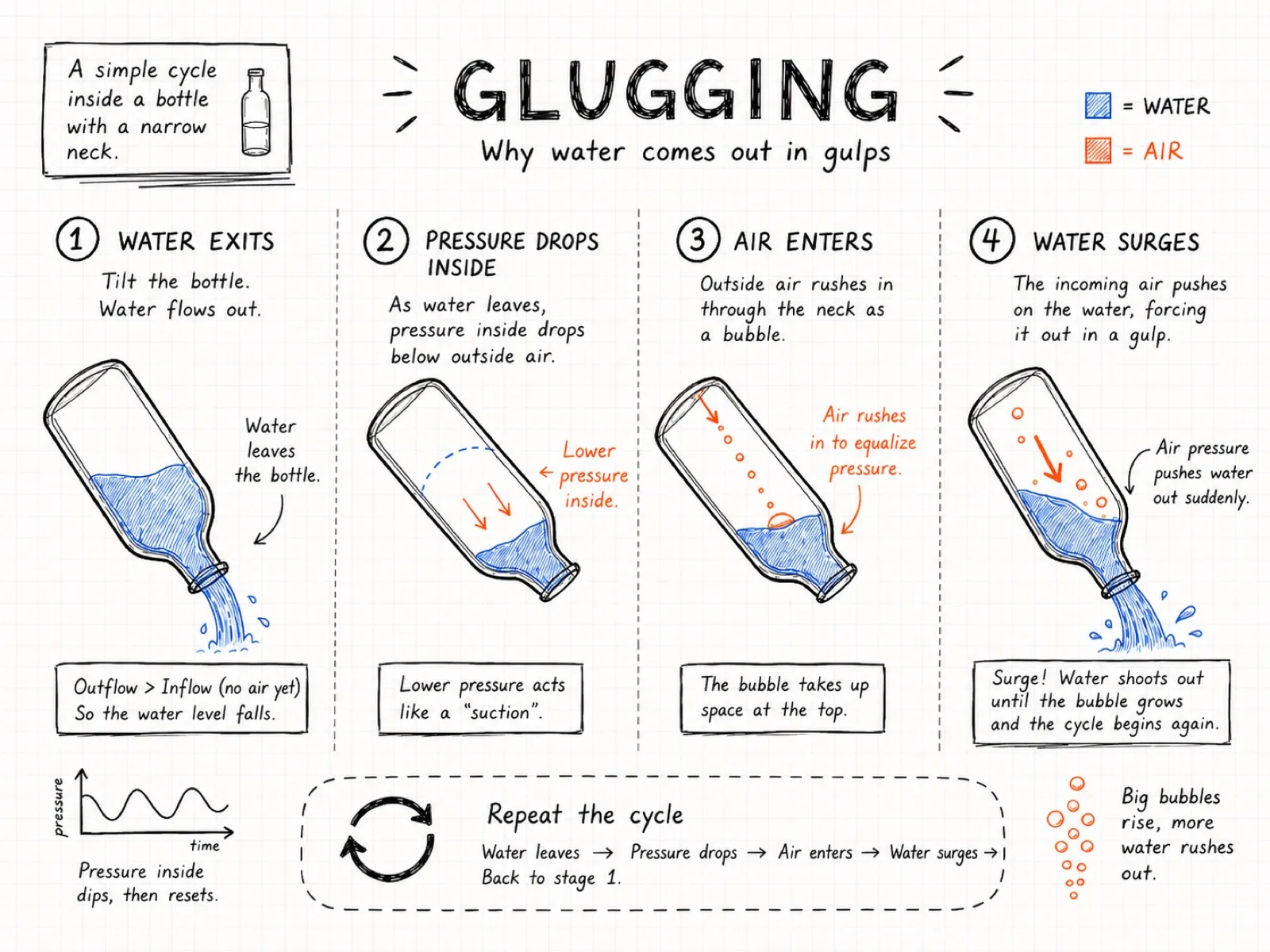
By the way, the glug has a name. It is called glugging, the glug-glug process, and it is a real subject in fluid dynamics. You tip the jug and water runs out through the narrow mouth. As it leaves, the pocket of air trapped above the water inside the jug grows, and its pressure falls below the air pressure outside. A partial vacuum. The outside air wants in to fill that low-pressure pocket, but the only door is the same mouth the water is pouring through. So air and water fight over one opening. The air loses for a beat, then shoves up through the stream as a fat bubble, the bubble breaks into the air pocket above, the pressure evens out, water surges again, the pressure drops again, and the next bubble forms. That stop-start loop is the glug. The pressure keeps pulsing in the air pocket and rings like blowing across a bottle top, a Helmholtz resonator, and that ringing is the sound you hear.